Privacy · how it works
Your information lives in the link, not on our servers.
Medical details are personal. Many online medical ID services keep your profile in an account on their servers. DigitalBracelet has no accounts and no database at all. Here is exactly what happens to what you type, who can see it, and how to change or retire a code.
Make a free, private medical ID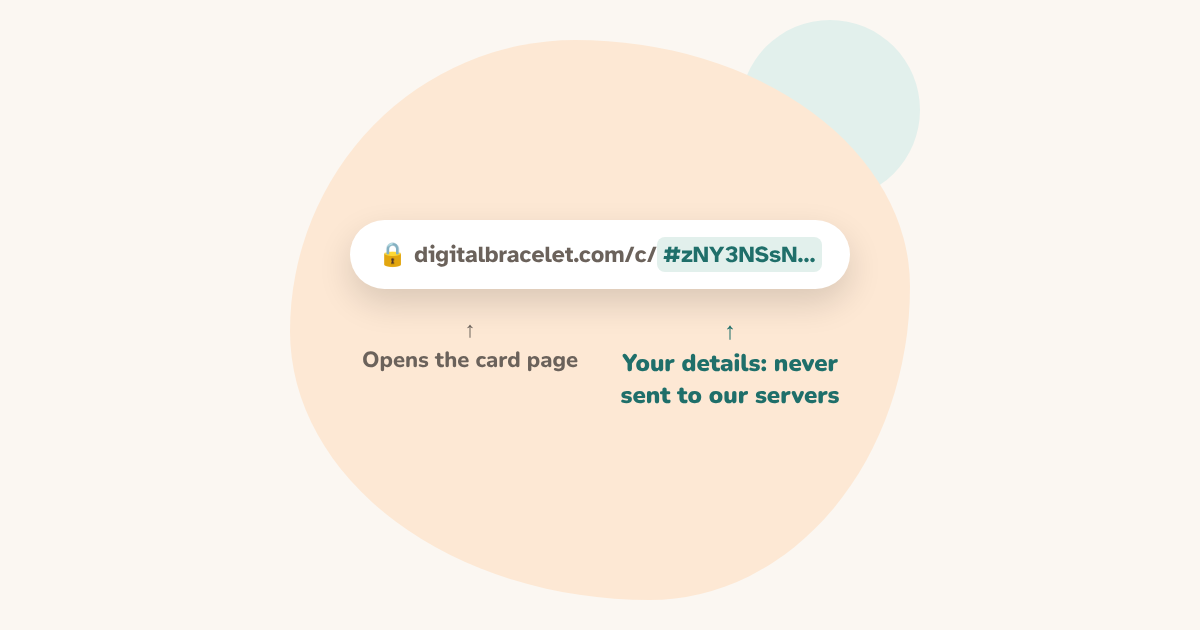
What happens when you create an ID
- You type your details on the page. Nothing is sent anywhere while you type.
- Your browser writes them into the link itself, compressed, in the part after the “#”.
- The QR code is drawn on your own device from that link.
- You download or print it. We never receive a copy.
What happens when someone scans it
- The helper’s phone asks our site for the card page.
- Browsers never send the part of a link after the “#” to a server, so your details are not in that request.
- The page reads your details from the link on the helper’s phone and shows the card. Nothing is sent back.
- Like any website, our host receives the normal page request, with the page address and an IP address, to deliver it. Your details are not part of it.
What we don’t have
- No accounts, no passwords, no sign-up.
- No database of profiles.
- No cookies, no analytics, no advertising trackers.
- No third-party scripts or fonts: everything is served from our own site.
What this means for you
- Nobody can break into a database of profiles that doesn’t exist, and we can’t sell data we never collected.
- Anyone who scans your code can read it, just like an engraved bracelet: include only what a helper needs.
- Anyone with a copy of the link or a photo of the code can read it too. Treat it like an engraved tag, not like a password.
- We can’t recover a lost code or change it for you: keep the edit link the site offers to email to yourself.
Changing or retiring a code
- Open your edit link, or create a new ID.
- Change what you need and make a new code.
- Replace the old tag, sticker or card: the old code keeps showing the old details, because they are written inside it.
- Destroy old printouts you no longer use.
Optional features work the same way
- The helper’s message opens their own text messaging app or WhatsApp. Their location is added only if they tick the box and allow it.
- The offline backup code is plain text inside a second QR code. It never touches a server.
- The calendar reminder is created on your device and holds no medical information.
- A logo added to a poster is read on your device and never uploaded.
For the technically curious
The profile is written as JSON, compressed with raw DEFLATE using the browser’s built-in CompressionStream, and encoded in base64url into the URL fragment. If compression doesn’t make the link shorter, the JSON is only encoded. The QR code is generated in the browser, the card page is served with no-referrer and noindex, and you can check the network tab: nothing is posted back.
Questions
Do you store my medical information?
No. There is no account and no database. Your information is written into the QR link itself, in the part after the “#”, which browsers never send to a server.
Can DigitalBracelet see my card when someone scans it?
No. Our host only receives a request for the card page, without the part after the “#”. The card is put together on the helper’s phone.
How do I delete my data?
There is nothing stored with us to delete. To retire a code, replace the tag, sticker or card and destroy old printouts: the information only exists where the code or link exists.
Is a QR medical ID as private as an engraved bracelet?
About the same: anyone holding it can read it. The difference is that a QR code can hold more, so choose carefully what you include.

Create your free emergency ID. Takes 3 minutes. No account. Free forever.
Make a free, private medical IDRelated pages
More practical guides
Sources
Published 17 October 2026