Travel · medical ID abroad
Abroad, the person who helps may not speak your language.
Travel health advice from the CDC and the NHS agrees: wear a medical ID or carry information about your condition. Abroad there is one more problem: the person who finds you may not read your language. Here is how to prepare, and how a QR medical ID can show first-aid steps in the helper’s own language.
Make a free medical ID for your trip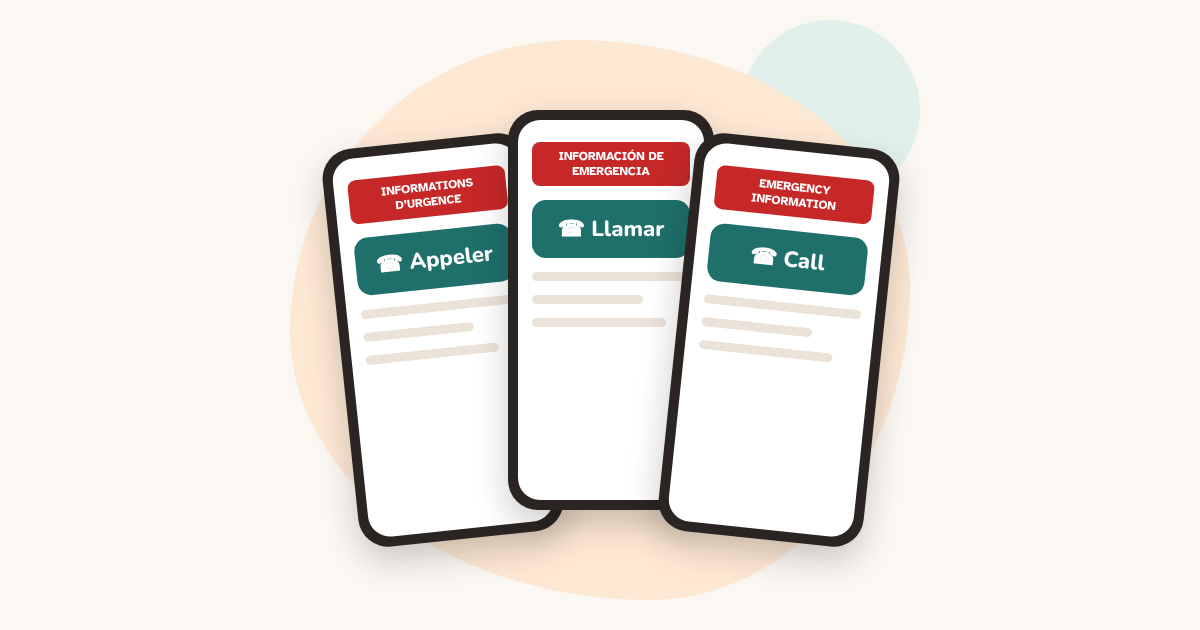
Before you go
- Wear a medical ID bracelet or carry medical information on you, as travel doctors advise.
- Ask your doctor for a letter about your condition, your medicines with their generic names and doses, your allergies and any equipment you need, with the doctor’s name and contact details.
- Keep medicines in your hand luggage, in their original packaging, with enough for the whole trip plus extra in case of delays.
- Check that your travel insurance covers your condition.
Know the emergency number
- 112 works free of charge everywhere in the European Union, from mobiles and landlines, and in many countries the operators can answer in more than the national language.
- 911 in the United States, Canada and Mexico; 999 in the UK; 000 in Australia.
- When you create your ID, choose the number for where you are going, so the helper can call it in one tap.
How the card handles languages
- Headings, buttons and first-aid steps open in the language of the helper’s phone: English, Spanish or French.
- If the helper’s phone uses another language, the card opens in the language you created it in.
- What you typed yourself stays in your words: names, medicines and your message. Use generic medicine names and short, simple sentences.
- Write every phone number with its country code, such as +44, +34 or +33.
No data abroad? Add the offline code
Many travellers switch off mobile data, and a helper visiting from another country may have none either. The free offline backup code holds the essentials as plain text inside the QR code itself, so any phone camera can read it with no internet.
Checklist for the trip
- Make or update your emergency ID, with phone numbers in international format.
- Choose the emergency number for your destination.
- Tick the offline backup code.
- Wear the bracelet or tag, and print the wallet card for your bag.
- Tell the people you travel with where it is and what to do.
Questions
Should I wear a medical ID when travelling?
Yes, if you live with a condition a stranger should know about. The CDC advises travellers with chronic illnesses to wear a medical alert bracelet or carry medical information on them.
Does 112 work everywhere?
112 is the emergency number across the European Union. Outside the EU, check the local number before you go: it is 911 in the United States, Canada and Mexico, 999 in the UK and 000 in Australia.
Will my card be translated into any language?
The headings, buttons and first-aid steps switch between English, Spanish and French, depending on the helper’s phone. What you type yourself, such as your message and medicine names, stays as you wrote it.
What if there is no mobile signal abroad?
Add the offline backup code: it shows the essentials as plain text with no internet. Keep a phone number in plain text too, on the tag or the wallet card.

Create your free emergency ID. Takes 3 minutes. No account. Free forever.
Make a free medical ID for your tripRelated pages
More practical guides
Sources
Published 17 October 2026