Personal alarms and medical ID · an honest comparison
One calls for help. The other tells helpers what to do.
A medical alert system, also called a personal alarm or telecare, lets someone call for help with a button, often through a 24-hour monitoring service. A medical ID tells whoever is already there what is wrong, who to call and how to help. They solve different problems, and many families end up using both.
Make a free medical ID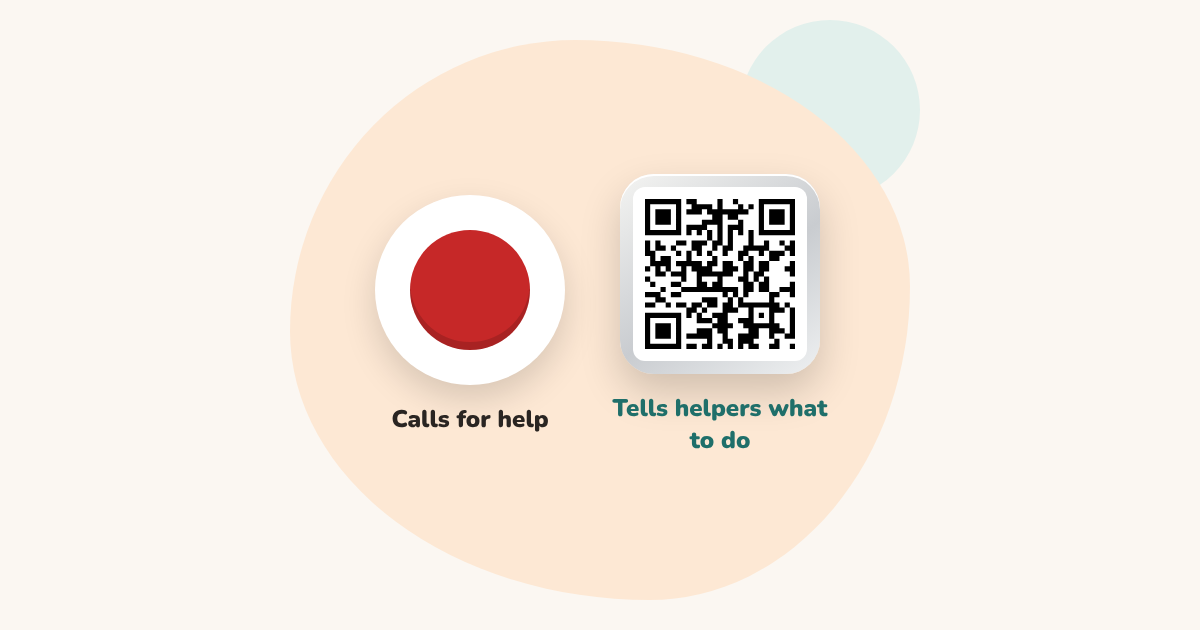
What each one does
| Medical alert system | Medical ID | |
|---|---|---|
| Main job | Calls for help when the button is pressed, or when a fall is detected on some models | Tells the person helping what is wrong, who to call and what to do |
| Who responds | A monitoring service or a family member, depending on the model | Whoever is there: a neighbour, a passer-by, a teacher, a paramedic |
| Where it works | At home, or outdoors with a mobile or GPS model | Anywhere it is worn or carried |
| What it costs | A device, and usually a monthly fee for monitored alarms | Free to make here, on a bracelet, tag or card you already have |
| What it needs | Charging, and a phone line or mobile signal | Nothing for the engraved or printed part; a phone to scan the QR code |
When a medical alert makes sense
- Someone lives alone and could fall or be taken ill without being able to reach a phone.
- Family live far away and want a service that answers day and night.
- Someone tends to walk about and get lost: some alarms include GPS so family and carers can see where they are.
When a medical ID makes sense
- A condition a stranger can’t see: epilepsy, diabetes, a severe allergy, blood thinners, a pacemaker.
- Someone who may not be able to explain: a young child, a person living with dementia, an autistic or non-verbal person.
- Anywhere away from home: school trips, the beach, travelling abroad.
Why many families use both
An alarm brings help. It doesn’t tell the neighbour who arrives first that your father takes blood thinners, or which medicines he is on, or that he may not remember his own address. A medical ID fills that gap. It keeps working away from home, with no subscription, and with an offline backup code it even works with no mobile signal.
Before you sign up for an alarm
- Add up the full cost over two or three years, not only the monthly price: device, set-up, monitoring and any contract.
- Check whether fall detection is included or costs extra.
- Ask your local social services: some provide alarms or basic monitoring, or can help with the cost.
- Read the cancellation terms before you sign.
Questions
Is a medical ID the same as a medical alert?
No. A medical ID gives information: it doesn’t call anyone by itself. The person helping uses it to know what to do and to call the family or emergency services.
Does DigitalBracelet replace a personal alarm?
No. If someone needs to call for help when they are alone, an alarm does that. DigitalBracelet adds what the people helping need to know, for free, and works alongside any alarm.
Do medical alert systems have a monthly fee?
Monitored alarms usually do. The NHS notes that basic alarms, which make a loud noise or alert a family member’s phone, can be quite cheap to buy, while monitored alarms and GPS systems cost more.
Can I add a medical ID to an alarm pendant?
Yes. A small QR sticker or tag on the pendant cord, a keyring or a wallet card works well, as long as it doesn’t cover the alarm button.

Create your free emergency ID. Takes 3 minutes. No account. Free forever.
Make a free medical IDRelated pages
More practical guides
Sources
Published 17 October 2026