Medical ID stickers people recognise
Print labels that say clearly "medical ID", with the condition and a number to call, for the things that go everywhere: school bags, bikes, wheelchairs, walkers, phone cases.
- No email, no sign-upNothing to register. Just fill in and print.
- Stays on your deviceWhat you type is never sent to us or stored online.
- Works offlineOnce this page is open, you can fill it in without internet.
- Print or save as PDFStraight away, no waiting and no download link by email.
Type in the boxes to fill it in, or leave them empty and write by hand after printing. To keep a PDF, choose “Save as PDF” as the printer in the window that opens. Fits A4 and US Letter paper.
Why a medical ID sticker helps
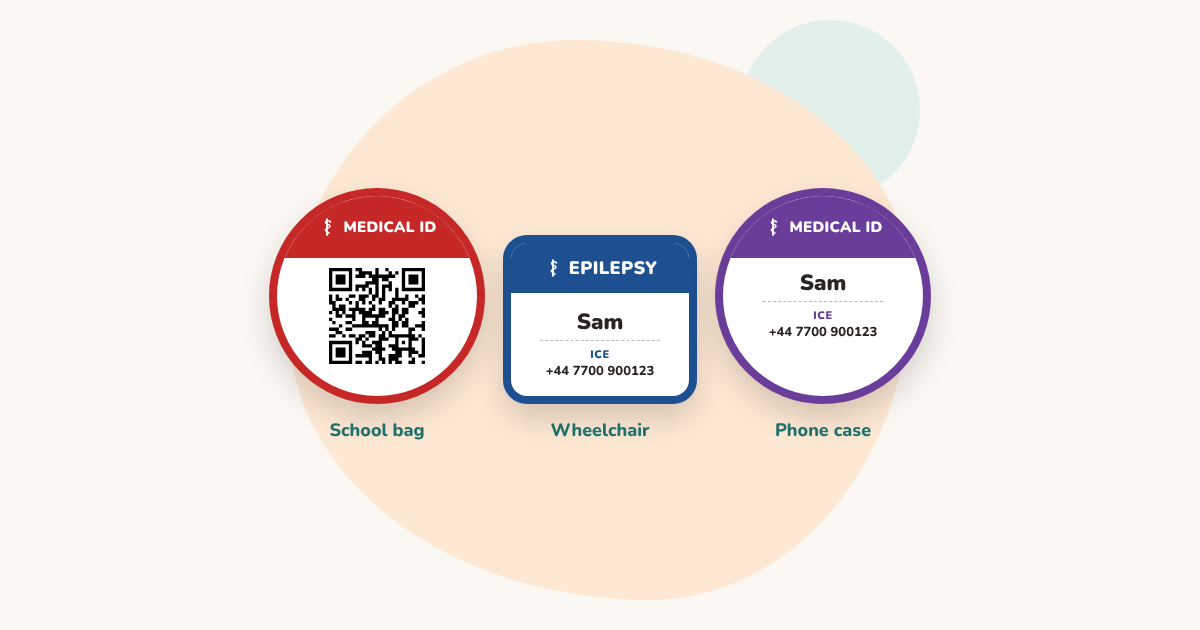
In an emergency, the people around you have very little time to work out what is going on. A phone number or a bare QR code on a bag says nothing: it could be a lost-property tag or an advert. A label that says MEDICAL ID, with the staff of Asclepius (a snake around a rod, a long-standing symbol of medicine), shows straight away that this is health information worth reading. Stickers go where a bracelet cannot: on the things that travel with you every day.
Where to put medical ID stickers
- School bags and lunch boxes: on the outside of the flap or strap, where a teacher, coach or bus driver will see it.
- Wheelchairs, walkers and mobility scooters: on the frame or the back of the seat, away from wheels and brakes.
- Walking sticks: just below the handle, with clear tape over the label.
- Bikes, scooters and helmets: on the frame near the handlebars, or on the outside of the helmet.
- Phone: on the back of the case. A label on the case can be read even when the phone is locked.
- Medicine cases: on the pouch that holds an inhaler, adrenaline pens or insulin, so the label travels with the medicine.
- Keys, luggage and sports bags: on a luggage tag or a key-ring tag.
- Car: near a child’s car seat or on the sun visor, never where it blocks the driver’s view.
Clothes: what works and what doesn’t
Paper and vinyl stickers do not survive the washing machine. For clothes, use iron-on or sew-in labels with the same words, put a sticker on a shoe tag, or slip a label into a coat pocket. This matters most for young children and for people living with dementia, who may not carry a bag.
What to write on the label
- The main line: MEDICAL ID, or the one condition a stranger must know first, such as EPILEPSY, SEVERE ALLERGY, DIABETES or AUTISM.
- A first name: it helps people speak to the person calmly. For a child, the first name is enough.
- A phone number to call, with the country code (+44, +1, +61…) if you travel.
- No home address: a phone number reaches family faster and keeps the address private.
- Capitals and short words: the label is small and may be read in a hurry.
ICE, EMERGENCY or CALL: the word before the number
You can choose the word printed before the phone number. All three work; pick the one that will be clearest where the sticker goes.
| ICE | In Case Of Emergency. Short, and understood in many countries: handy when you travel or when the label is small. |
|---|---|
| EMERGENCY | The full word: the clearest for anyone who reads it. |
| CALL | Simple and direct: it tells people what to do with the number. |
With or without a QR code
The labels on this page have no QR code: you type or write a name and a number, and that is enough for many uses. To give more, such as several contacts, allergies, medicines and first-aid steps written for the person helping, make your free emergency ID and open “Medical ID sticker”: you get the same label with your QR code, ready to download or print. A QR sticker shows your details as they were when you made it, so print a new one when they change, and test it with two phones before you rely on it.
A sticker adds to a bracelet, it does not replace it
A bracelet or necklace stays on the body. A sticker stays with the bag, phone or wheelchair it is on, and those can be left behind. Use stickers as an extra, alongside a medical ID bracelet or a wallet card.
Good to know
- Print at 100% (“actual size”), not “fit to page”, so the labels keep their size.
- Plain sticker paper is fine indoors. For bikes, wheelchairs and lunch boxes, use waterproof vinyl sticker paper, or cover the label with clear laminate or wide tape.
- Cut round labels with scissors or a circle punch; square labels with a ruler and a craft knife.
- Red is the most recognised colour for medical IDs. Other colours are fine if they matter to you: helpers read the words, not the colour.
- Replace labels that fade or peel. A label nobody can read does not help.
Questions
Are medical ID stickers official?
No. There is no official standard for medical ID stickers. What matters is that they are easy to understand: clear words such as MEDICAL ID, a recognised medical symbol and a number to call.
Which colour should a medical ID sticker be?
Red is the most recognised colour for medical IDs, so it is the default here. There are no official colours for conditions, and other colours work too: people read the words, not the colour.
Is it safe to put my child’s name on a sticker?
Use the first name only, with a parent’s phone number. Never add the home address.
Are the stickers waterproof?
Plain sticker paper is not. Use waterproof vinyl sticker paper, or cover the label with clear laminate or wide clear tape.
What does ICE mean on a sticker?
In Case Of Emergency. Written before a phone number, it tells people who to call. It is short and understood in many countries.
Can a sticker replace a medical ID bracelet?
No. A bracelet or necklace stays on the body, while a sticker stays with the bag, phone or wheelchair it is on. Use stickers as an extra.
Related pages

Pair it with a digital ID. A bracelet with a QR code goes everywhere the paper doesn’t. Make one in three minutes, for free.
Create a free ID